
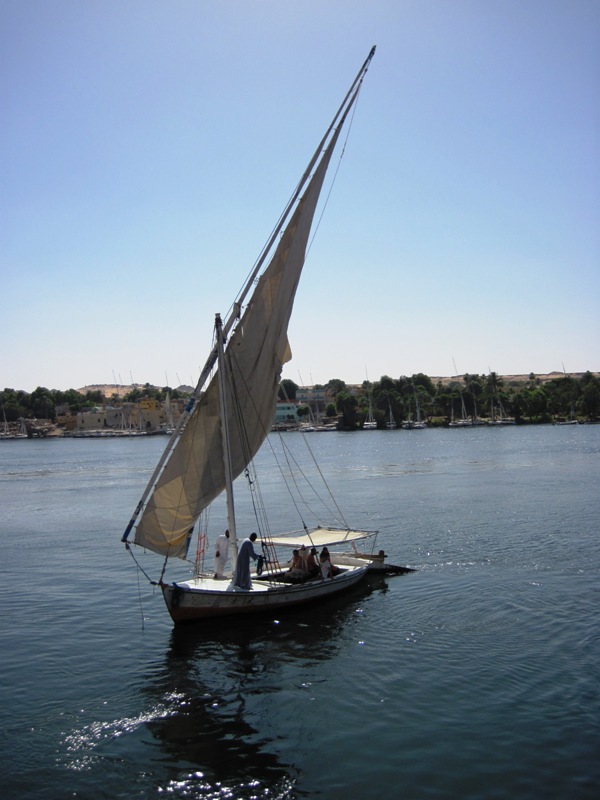
Feluccas ply the river Nile, taking tourists on trips as long as five days...
The area in which present day Aswan stands, was famous for its granite, and it is from here that boats plied the Nile, carrying massive stabs of it to the temples that were constantly being built elsewhere in Egypt.
There is an “Unfinished Obelisk” just outside town, which when complete, would have weighed almost 1200 tons!! It is 42 metres long, and would have been the heaviest single piece of stone ever fashioned by man, had it been completed. Due to a flaw found almost at the time of its completion, work was stopped on it… There are very few markings chiseled into the stone, and historians have no idea who it was made for, or where it was intended to stand…
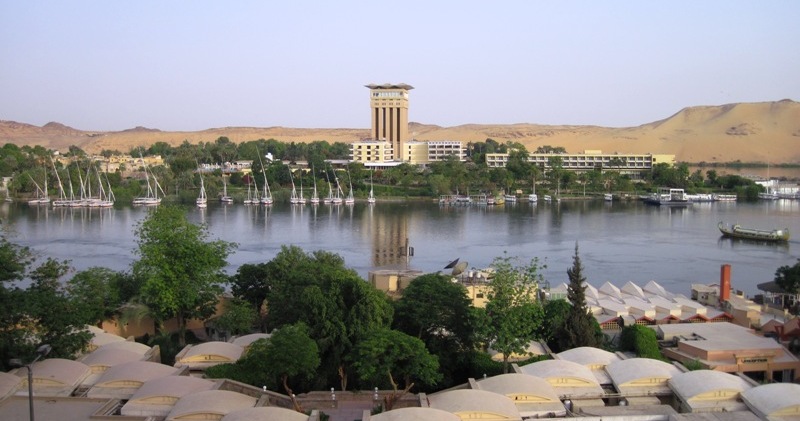
The Movenpick Hotel with it's distinctive tower, dominates the Elephantine Island...
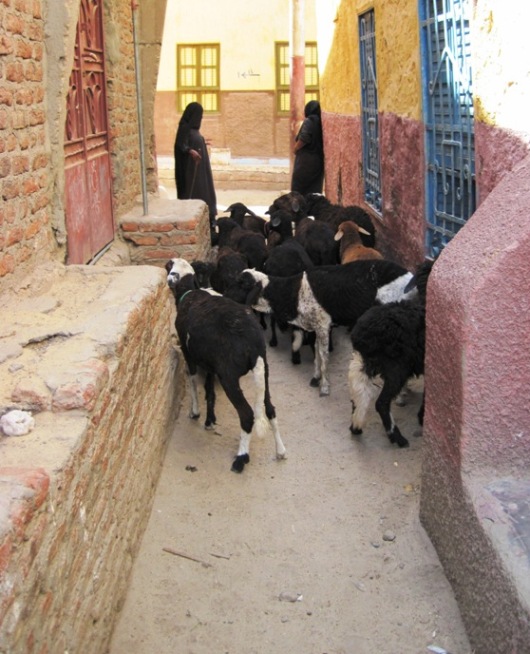
Traffic jam on the narrow streets of the little village we walked through...
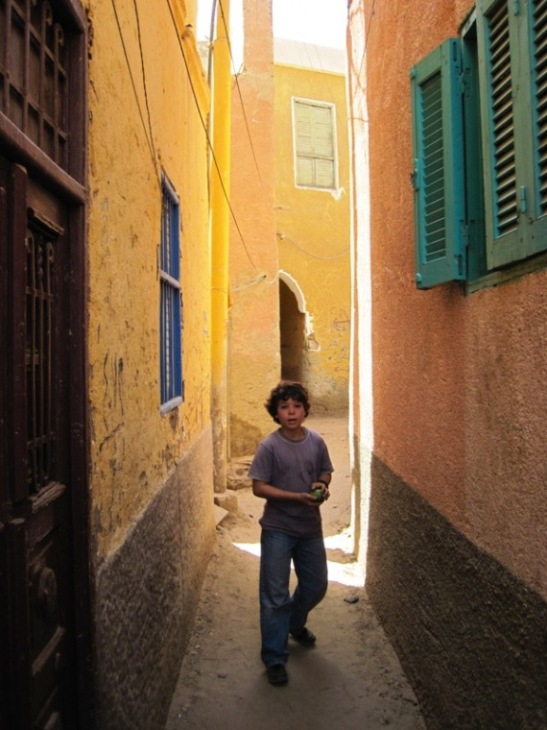
Sami finds a smoother passage down a winding lane...
Directly across from our hotel, lay Elephantine Island, dominated by the concrete tower of the Movenpick Hotel. The island is steeped in history going back thousands of years, and was named not only for the many elephant shaped rocks on its southern shore, but also because it served as a trading place for Ivory.
There is a shuttle boat that crosses over to the island throughout the day and after landing, we walked through the village and down to the southern end to where the oldest museum in Egypt stands. It was built in 1898, to house the engineer who oversaw the construction of the original Aswan Dam, and on completion of the dam in 1912, it was used to house many of the artifacts that were discovered on the Island.
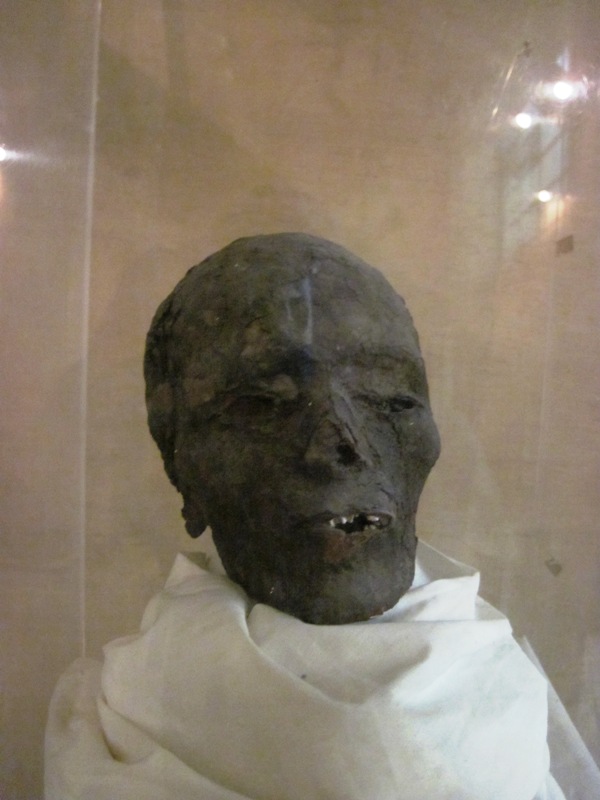
This guy apparently died while waiting for the dentisit to return from a fishing trip further up the Nile...
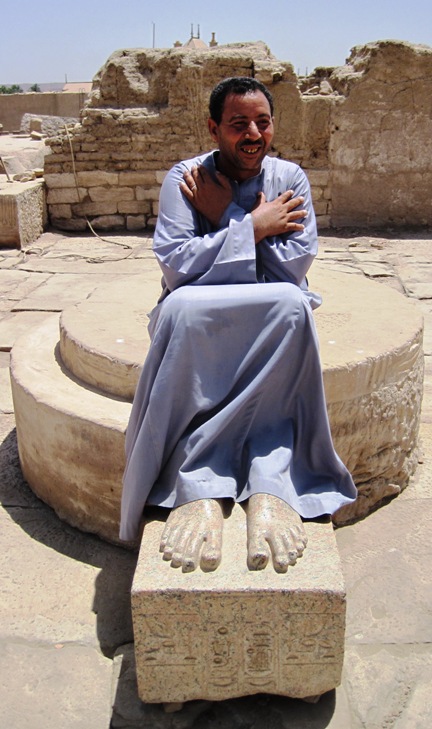
A self-appointed guide joined us for a walk among the ruins, and made us laugh with this pose on the site where a statue of Ramses ll once stood... Only the feet now remain...
Elephantine Island was the southern border post between Upper and Lower Egypt, and lies just north of the 1st Cataracts or rapids found on the Nile.
The Pharaoh’s most trusted scribes were stationed here, and controlled all trade coming up from lands to the south of it.Their mummified remains have been found on the island and although not in the best of condition, they are nevertheless a reminder of those ancient times…
There is also a Nileometer situated on the island, and this was used to calculate the level of the river in order to establish how much flooding would take place further downstream in Egypt.
From this further calculations could be made to determine the size of the annual harvests the farmers could expect… A tax was paid to the Pharaoh, based on the predictions made by the scribes on Elephantine Island. These scribes were also responsible for documenting all tributes and gifts that were sent annually to the Pharoah from Nubia and further afield.
A garrison of soldiers was also stationed on the island, and were Upper Egypt’s first line of defence…
There is evidence that both the Greeks and the Romans also made their mark on the island, and built temples of their own, where they worshiped both the Egyptian Gods, and those that they introduced to Egypt.
Excavations of the village which was situated around the temples continues even today, and more artifacts are added to those in the museum on a regular basis… Work will begin again when the worst of the summer heat dissipates, and the German and Swiss teams return from their European vacations…
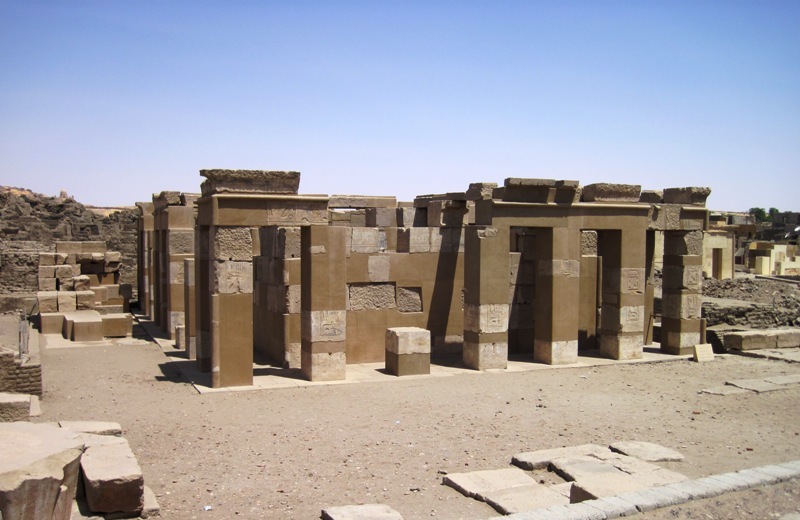
The remains of the Temple of Khumn. Only a few of the original sandstone blocks have survived...

Hieroglyphics chiseled almost 3000 years ago...
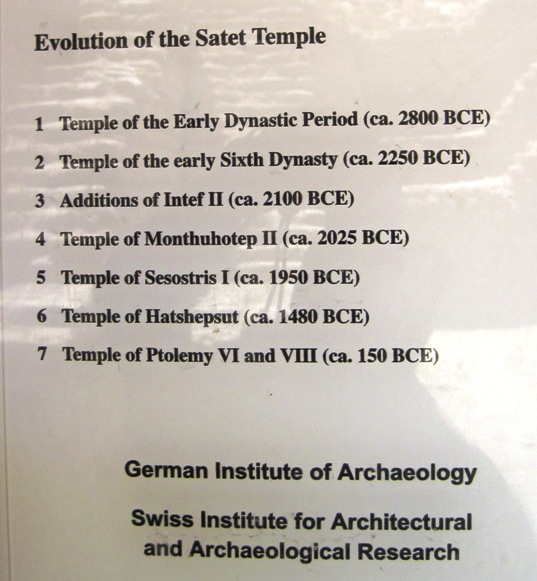
Successive temples were built either on top of older ones, or incorporated and made bigger as time went on...
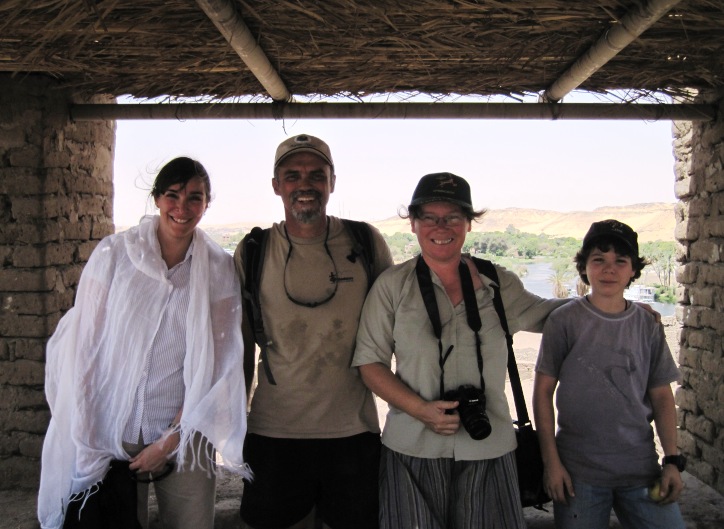
Annie Gauthier, Marie and Sami... The only shade we could find near the temple...
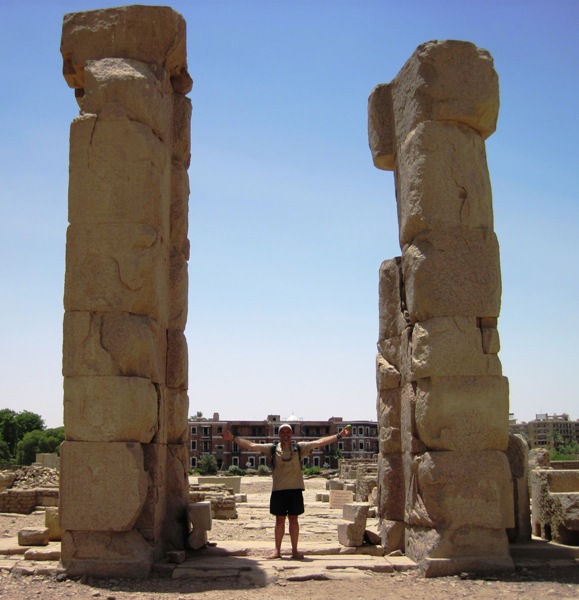
These columns were erected by Ramses ll and were part of a much larger structure which has been lost to time...
While walking around in the museum, we met Annie Gauthier, a French-Canadian from Montreal, who was on a tour of Egypt on her own. She joined us while we walked through the ruins of the Temple of Khumn and the village, and then went back across the river with us to have lunch in the old market.
Due to the fact that Egyptian men make things a little unpleasant for any European women walking around unaccompanied by a man, I offered to walk Annie back to her hotel. (See, I can be chivalrous if I want to…!) She had been propositioned many times already, and was clearly uncomfortable with this, on occasion I had heard her telling men that her husband was waiting for her at the hotel, but this hardly put the amorous Egyptians off…!! Apparently, many single European women come to Egypt for a little “horizontal entertainment” and this had led the men-folk here to believe that any woman walking around on her own is not here to visit archeological sites only… They even go as far as groping and touching woman in public…!! I am not sure which part of their religion condones this, but it certainly flies in the face of their claims to be staunch Moslems…
The walk back to the Sara Hotel where Annie was staying, took over an hour in 40° heat… By the time we got there, we were both knackered, and badly in need of something to drink… There was no way I was walking back to the Hathor Hotel, so I summoned a taxi and arranged for Annie to meet us all at the Nubian Museum later that evening.
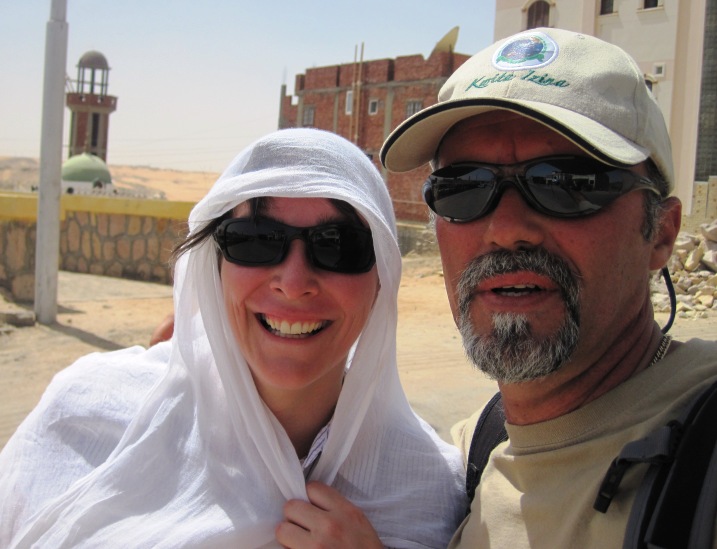
Annie and I sweating bullets in the afternoon sun, on our long walk back to the her hotel...
©GBWT 2010
Oh good; your new digs have a mirror! Thanks for sharing your fantastic journey with all of us. I know how long it takes for you to do this. We really do appreciate it. Love you xx