
There was a bit of consternation when I lifted the cover off the bike this morning… A large white cat had taken up residence on my seat, and as I pulled the cover back, it took off like a rocket, scaring the hell out of me…!! After the incident with the wall the day before, I was not in the least bit surprised that the Big Fella had not warned me about the the presence of the cat…
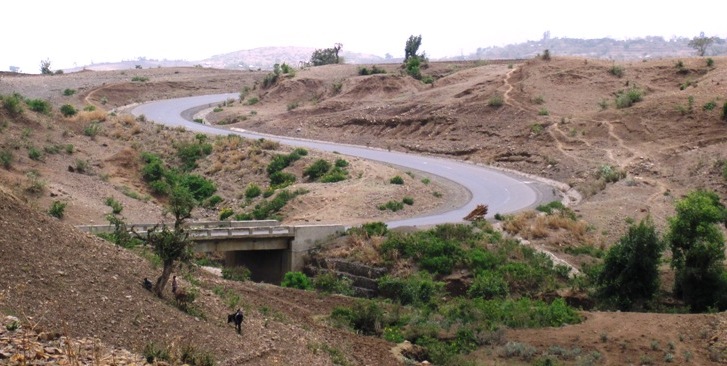
The road to Gondar winds through a dry and dusty landscape...
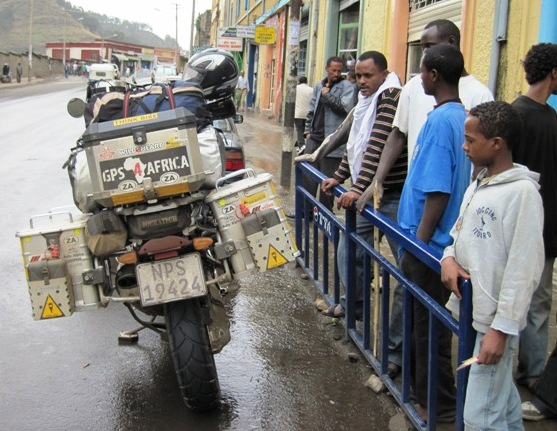
The Big Fella draws a crowd once again...This time on the central piazza in Gondar...
With Gondar less than 200 kms due north of Bahir Dar, I left the Papyrus Hotel shortly before lunch and went looking for a filling station to refuel at before heading out. Just to the north of town, I crossed the bridge spanning the Blue Nile, and was quickly into the dry and dusty countryside. The road surface was smooth and with very little traffic about, I was able to rid the motor of any carbon buildup it might have been suffering from… The Big Fella was feeling a little better under me now, or maybe I was just getting used to riding in a slightly different position than I had been for the last 16 000 odd kilometres…
We breezed through the little towns of Hamusit and Werota, skirting the Eastern shores of Lake Tana, and then took a wrong turning in Addis Zemen. The main road goes around a traffic circle, and the exit to the Gondar road is poorly marked… I turned back after a local ran into the road and waved me back the way I had come, shouting, “Gondar… Gondar!” and pointed back the way I had come…
A massive Inselberg dominates the town, and the road winds its way up and over a range of mountains behind it, before leveling out onto a plateau, and then dipping down through another mountain pass into a long flat valley where the town of Maksegnit is located. The population of this area is not as dense as those before it, and less people, meant less cattle and goats, so we were able to enjoy the excellent road conditions, and I could concentrate again on getting into a good rhythm on the bike… It seemed to “twitch” going into fast corners, and I had to make constant adjustments to my position until I could ride without worrying about the bike’s reactions to cornering…
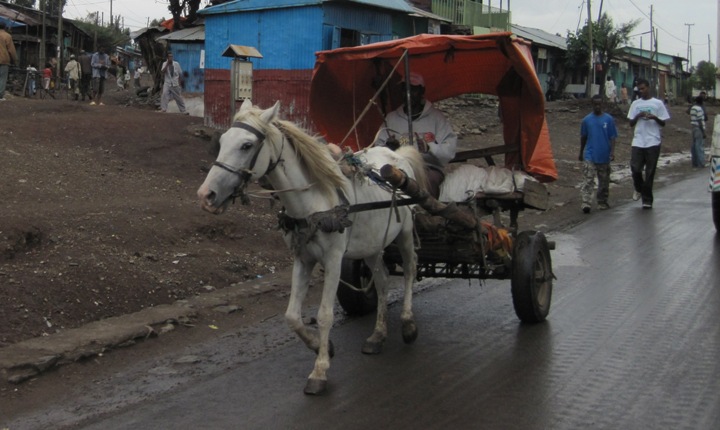
On the wet streets of Gondar... Cheaper than a Tuk-Tuk, but infintely slower...
A light rain was falling as I rode up the main street of Gondar… The first hotel I stopped at was the “Quara”. It stands wedged between a dingy little supermarket and “hole in the wall” general dealer, and still looks like the run down government hotel that it once was… I met an Italian guy and his friend, who had ridden their Landrover up from Bela-Bela (Warmbaths) and were on their way to Italy. They had traveled a similar route to the one I had taken, so we were able to share our experiences and laugh about the tougher sections we had ridden through…
The management of the Quara were not prepared to drop their price for a room below 370.00 Birr, and I decided to look for cheaper accommodation further up the hill… I had been warned that Gondar was an expensive destination in comparison to other Ethiopian town, and this was proving correct. I was also told that it was impossible to use the words, “Gondar”, “Clean”,” Cheap” and “Hotel” in one sentence, without adding the word “not” into the mix… This was proving true… The town is grubby, with litter scattered everywhere… Hardly worthy of a World Heritage Site…
Gelagay, my guide in Bahir Dar, had given me the contact details of a friend of his in Gondar, and I called “Samy” to assist me with finding cheaper accommodation. Within a short while, I was following him further up the road to the Land Mark International Hotel, where I was able to negotiate a much more favorable rate with the friendly staff and the owner’s son. I had timed my arrival in Gondar to allow for an afternoon of sightseeing, and Samy, who is a very well known guide in the area, was able to make all the necessary arrangements for me to do this. He had other clients waiting for him, and passed me on to another guide who works with him.
Steven and I hopped aboard a Tuk-Tuk, and headed for The Royal Enclosure, a large, high-walled area on the slopes in the centre of town. On entering through the imposing archway, I was immediately transported back in time… It was one of those “jaw-dropping” moments for me… Set in open parkland, there are six castles, each built by the different kings and emperors that ruled here centuries ago. It was easy to see why this was dubbed the “Camelot of Africa”…
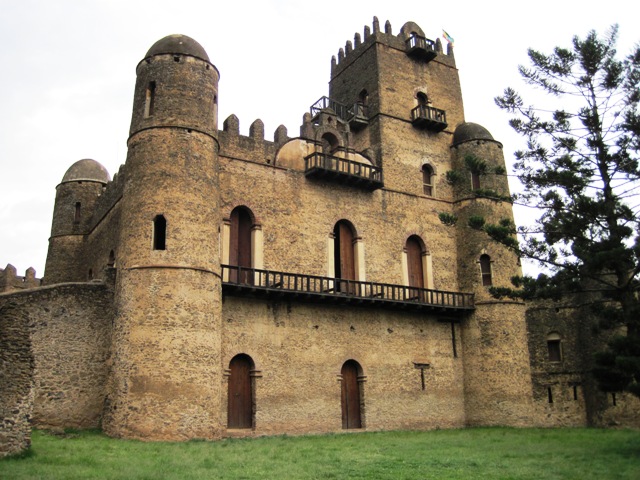
The first castle, built by Fasilidis in the early 17th Century...
My guide rattled off the facts and figures, many of which were unfortunately quickly forgotten as I tried to get my head around what I was seeing… I was overwhelmed by the magnitude of some of the buildings, and would have preferred to spend the day wandering around on my own to absorb more of the history of this amazing place…
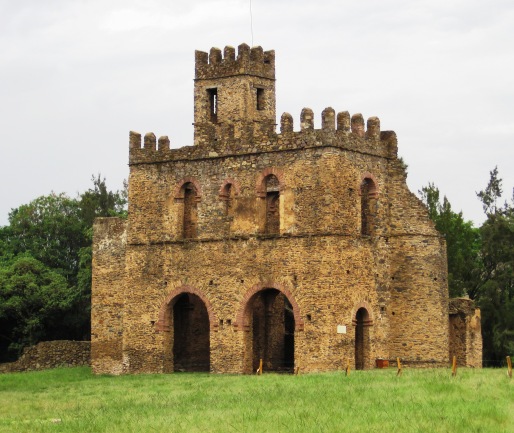
This castle was built by the Emperor Yasu...
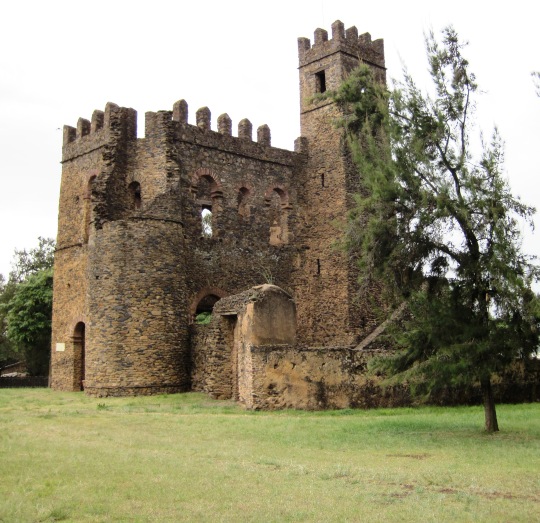
This castle came complete with steam bath...
Each palace had been built by a succession of Emperors, all descended from the Queen of Sheba, the Ethiopian Princess, who after a visit to King Solomon, returned to Ethiopia and discovered she was “in a family way”, so to speak… The Ethiopian Royal Family line began thus, and ended with death of the last Emperor, Heilie Selassie, “The Lion of Judah”…
Emperor Fasilidas began the building process, and his sons and grandsons each built their own palaces on the grounds. Gondar was the capital of Ethiopia for more than 250 years. Axum had been the first capital, followed by Lalibela and then Gondar. Modern day Addis is therefore the fourth capital in the history of Ethiopia.
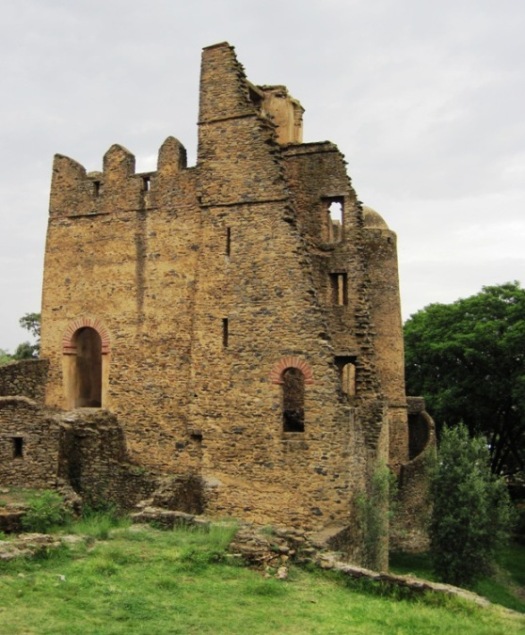
The upper floors of this castle were destroyed when the British bombed the Italians into submission...
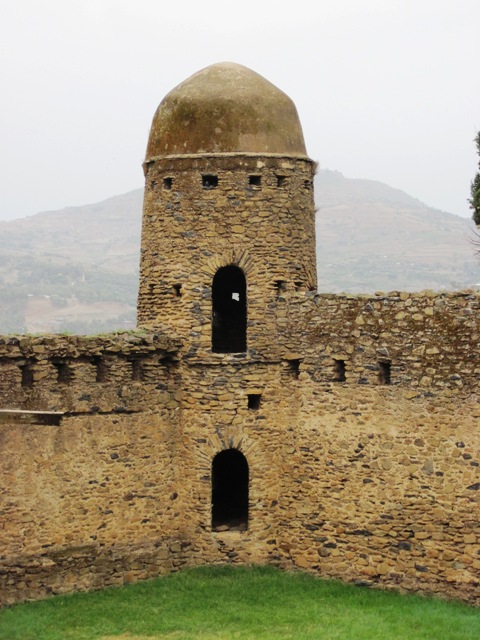
Watch Tower on the northern perimeter...
Steven took me through each palace, explaining the layouts, and what each was famous for. One of them had a row of stables built into the outer wall, where visiting dignitaries “parked” their animals while enjoying banquets held in their honour beyond the wall of the stable. Ready for a quick getaway, perhaps?
Another had a series of “saunas”, rooms heated from below by pouring water on hot rocks. The steam went up through holes in the floor of the lower room, filling the one above… The horns of cattle had been inlaid into the wall, where clothes could be hung while they enjoyed their saunas. Some of the original horns are still embedded in the wall… Others have been nicked by by tourists…
Behind the main palace was a massive water reservoir, dug into the ground and fed by rain water, funneled through a series if stone pipes and gutters from the roof of the castle. In dry periods, water had to be transported up from the river below, using large earthenware jugs, strapped to the backs of donkeys… The path down to the river is a steep one, and being a donkey even in those days, could not have been much fun…!!
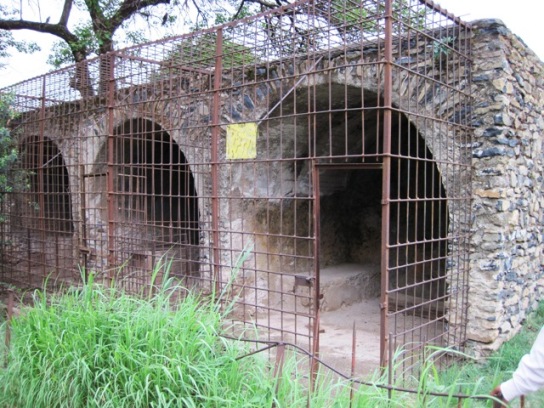
Enclosure where the Lions were kept as a symbol of the power of the monarchy...
With the lion being an important symbol of their power, it is no wonder they had a lion enclosure on the grounds of the castles. The Black-maned, Abyssinian Lions housed here were well fed and treated like royalty themselves.
The Italians occupied the grounds of the castles between 1936 and 1941, making it their Official Headquarters, and in their infinite wisdom, actually had the outer walls of one of the castles plastered, to make themselves feel “more at home”.
The British launched an aerial assault on the grounds of the castles in order to dislodge the Macaroni Munchers, and I fancy it was because they were intent on doing a little more plastering… However, it seem our English friends used a little “too much force” and damaged many of the buildings in the process, also destroying a massive archway leading to the largest of the palaces… The British should have known better… History has shown that a few boxes of firecrackers would have been more than enough to get the Italians reaching for the sky…
There is a still a strong Italian influence in the town, with many buildings surrounding the central piazza built in the Art Deco style, popular in the 40’s… Most of the Italian buildings are painted yellow, making them easily recognizable for a distance… All the traffic circles are also known as piazzas, and many Ferengis such as myself, are greeted in Italian by the locals…
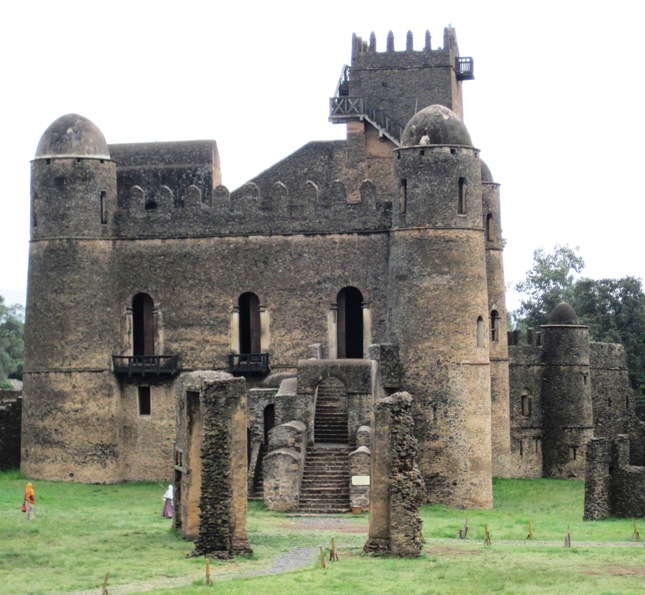
The ladies in the foreground give some idea of the size of this castle...
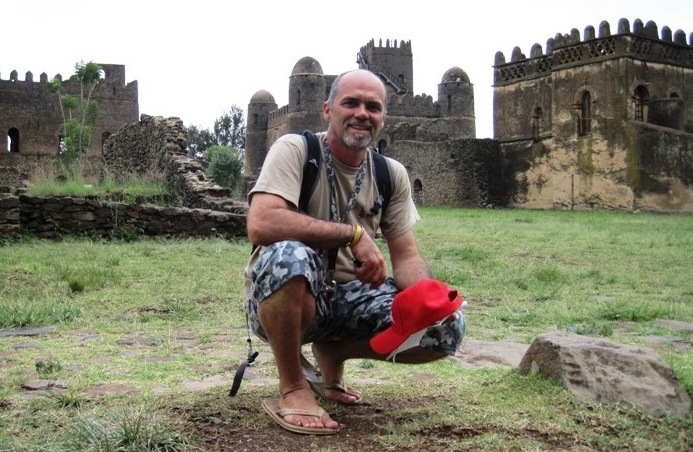
Three of the castles can be seen behind me, with the one plastered by the Italians on the right...
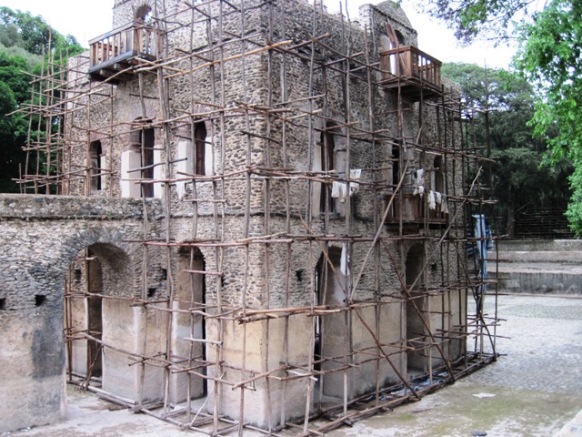
Emperor Fasilidis's "Home from Home" above the bathing pool...
After our visit to the Royal Enclosure, we toured the Baths of Fasilidas, where the Emperor spent much of his time, bathing in the massive pool that was built around and under a small residence, and accessed by a walkway above the waters. The Norwegian government is currently funding the restoration of this World Heritage Site, which is the scene of an annual pilgrimage by thousands of Ethiopians, who come here from the 18th to the 21st of January every year, to commemorate the baptism of Jesus by John the Baptist. The pool is filled, and then blessed by a procession of priests, after which the general populace are invited to “bathe” in the waters…
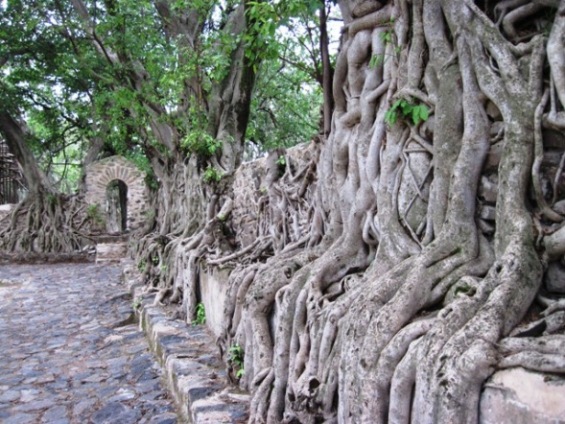
The Ficus trees are taking over...
Massive Ficus Trees have grown into the outer walls of the Baths, and I wasn’t sure if they were holding the walls together, or slowly assisting in their destruction… Time will tell… In the open parkland beyond the walls, is a tomb that houses the emperor’s favourite horse. I found this touching, and in stark contrast to the manner in which Ethiopians treat their animals today…
My visit to these two historical sites has given me the urge to come back to Ethiopia one day, to spend more time touring these and many other places in the country… I would not have time to visit Axum or Lalibela, as my medium term goal was to get to the northern tip of Norway before the middle of August, (before that fluffy white stuff wiped the memories of the Scandinavian Summer away…!) and many miles lay between Gondar and the Arctic Circle…

The Norwegian government is hard at work restoring this World Heritage site...
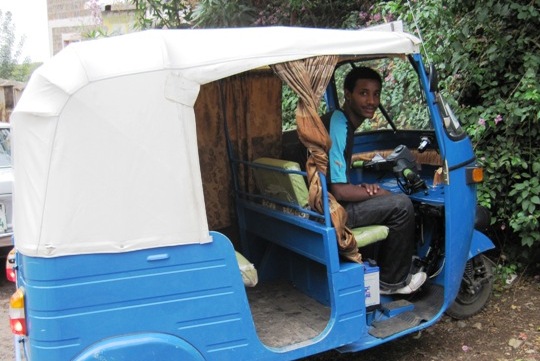
The Tuk-Tuk that we used to see the sights of Gondar...
The rainy season was also upon us, and the road to Axum was apparently in worse state than the one between Isiolo and Moyale in Kenya… To get to Lalibela, I would have to fly from Gondar… The road through the Simien Mountains was in the process of being battered by the rain. These mountains reach to over 4500 m.a.s.l. in places, and if rain was already falling on the “lowlands”, I could imagine what it was doing up in the higher altitudes… Lalibela and the Simien Mountains would have to wait for my next visit to this amazing country of many contrasts…
But before I left Gondar, there was one more “must see” place I had to visit… Our trusty Tuk-Tuk driver was waiting outside to take us there…
©GBWT 2010
did you get to Lalibela? The Jerusalem of Africa?
Next time, Buddy… Next time….
Next time you see her, tell her I love her.