
Malcolm had assured me that with careful planning, I should be able to “do Bahrain in a day”. The island is not much bigger than one of the larger cities of the world, and has a population of barely more than a million people, half of which are migrant workers…
It is made up of 36 separate islands, and together they total less than 750 km2… More than 95% of the population live on the two main islands that are connected by bridges…
I also learned that the highest point of the island is only 122 metres above sea level…!! “Not too many hilly sections, then…”, I thought to myself…
Armed with my list of things to see, we arrived at his offices where the driver and guide he had arranged was due to meet us…
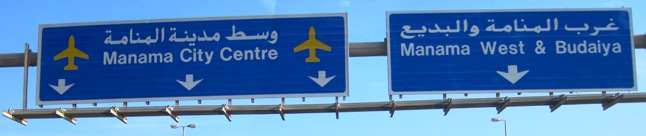
Heading into the city to Malcolm's office...
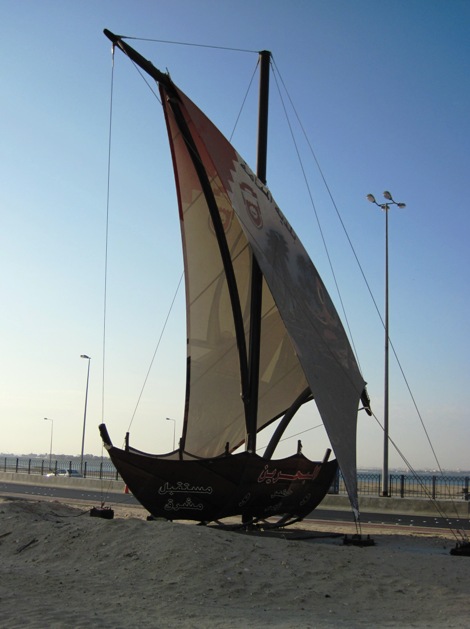
High and dry...!! This is an area marker in Bahrain... Neat...!!
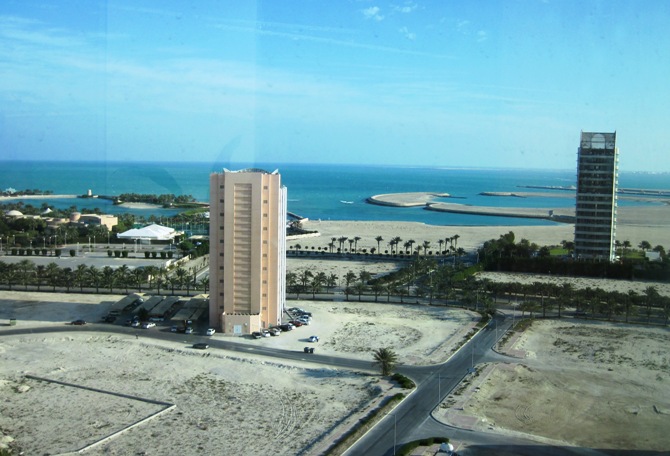
And this is the view from his office...!! Must be tough concentrating under these difficult conditions...!!
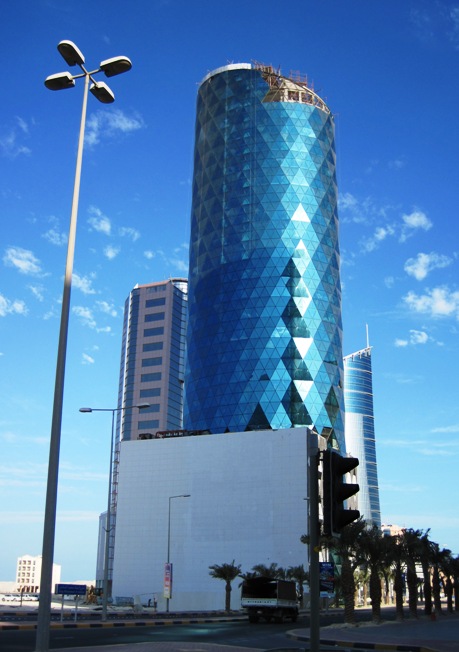
Bahrain's capital Manama, is well on it's way to doing a "Dubai"...!!
The view from Malcolm’s office is breathtaking to say the least…!!
The floor to ceiling windows look out onto the bay where land is constantly being reclaimed for later development…
Looking at the open areas in front of the building, I wondered how long it would be before all Malcolm would see is a forest of mega-structures…
Bahrain, like it’s neighbours in the gulf, is expanding rapidly, and futuristic buildings are being erected to rival those in Abu Dhabi and Dubai…
When will it all stop…??
There seems to be no shortage of companies wanting to either relocate here, or open satellite offices from where they get all those juicy tax breaks…!!
My guide and driver for the day was waiting for us, and at first, Malcolm and I were alarmed by the fact that of all the sights I mentioned I wanted to see, Ahmed had only visited two of them…!!
In fact, he had hardly ever been out of the capital in the 20 years he had lived here…!!
We figured that as Bahrain was so small, that the chance of getting lost was minimal, and as I was later to discover, everything is so well sigh-posted that getting around from place to place was a bit of a doddle…
Well, most of the time, anyway…!!
Our first stop was the Bahrain Fort, where early civilizations dating back to 2300 B.C. occupied the site. It is thought that the site was the capital of Dilmun, as Bahrain was known in ancient times…
It later served as a trading outpost and fort for the Portuguese from 1521 A.D., who controlled and traded in the Gulf until they were sent packing by the “Sand Dwellers” about 80 years later…
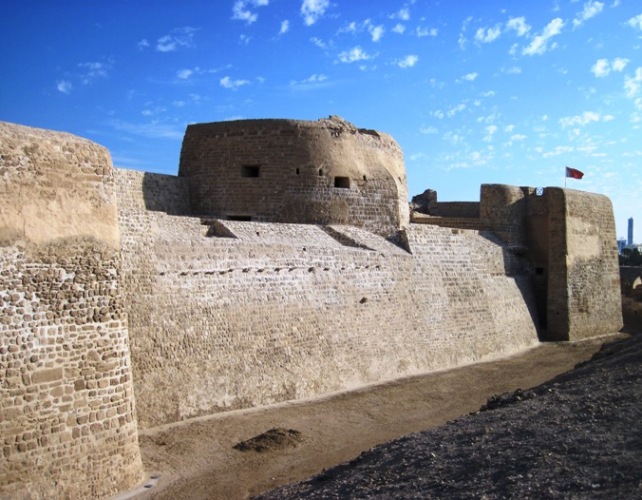
The Bahrain Fort, our first stop for the day...
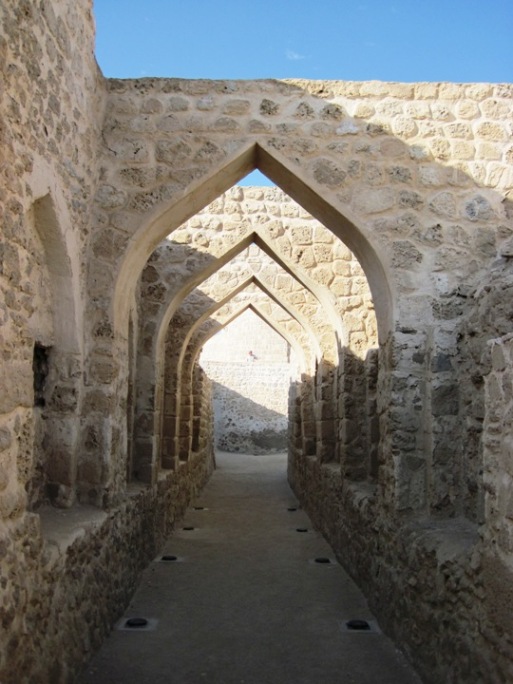
Entrance to the central courtyard...
In order to gain entry to the grounds of the fort, we had to first rouse the gate guard from the short stint of “inner eyelid inspection” that he had been indulging in…
His look of bewilderment suggested that he had never before admitted visitors this early in the morning…!!
The fort was far bigger than I expected it to be, and was surrounded by a deep ditch. It is doubtful if it had ever served as a moat, as water has always been rather scarce in this area…!1
Extensive renovations are presently underway, and walkways are being built around its perimeter…
We surprised a group of workers enjoying their breakfast, and were waved through to walk around the inner passageways on our own…
There was no information available on the history of the fort, which was disappointing, but I guess once the structure has been completely renovated, this little matter will be rectified…
Ahmed had last visited the fort when he was in junior school, and could not provide and information on its history… Nevertheless, between us we managed to work out what went on in the fort and what the various buildings had been used for…
We climbed the numerous stairways leading up to the battlements where cannon had once stood, guarding the bay and the city that stood beyond it in ancient times…
The fort has for years been Bahrain’s biggest tourist attractions, and the money being spent on the structure will no doubt be recouped in the years to come… Even in it’s current state, it is well worth visiting… Judging by the volume of floodlights being installed, I assume it will be offering night time visits as well…
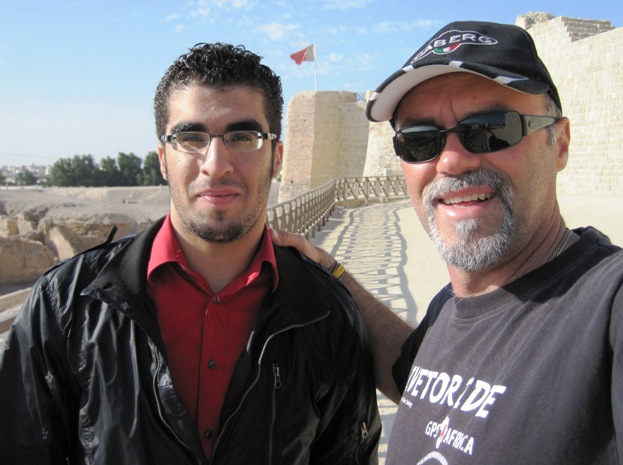
My trusty guide and driver for the day, Ahmed Shams...
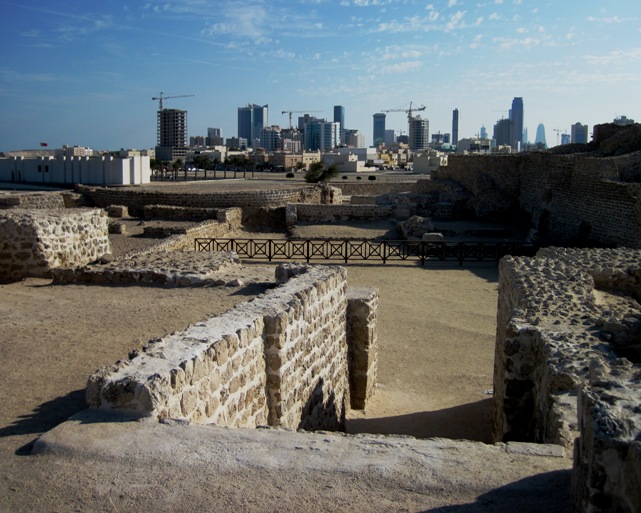
Looking out over the old to the highrise buildings of the new...
Bahrain had for centuries been the centre of the pearl fishing industry, and it was the control of this wealth that initially brought Europeans into the Gulf… This industry continued to be a major source of income until the 1930’s when cultured pearls produced in Japan led to it’s collapse…
Back on the motorway, I noticed the sign indicating that Saudi Arabia lay directly ahead of us, and I decided that this was the last opportunity for me to try and get a foot, or preferably both feet, on Saudi soil… I convinced Ahmed to drive across the causeway that connects Bahrain to the mainland of Saudi Arabia, and after paying the R40.00 toll fee, we headed towards the country that had done its best to prevent me from entering it…
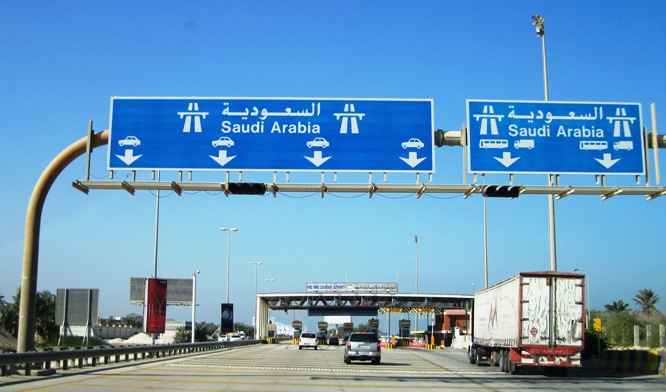
Let's go to Saudi shall wee...!! Approaching the toll gate which leads to the causeway...
Knowing that the Saudis controlled entry and exit rather zealously, we approached the border with care… The King Fayad Causeway was completed in 1985, and the 25 km long, four-lane motorway was built in three sections… The first leads to and crosses the island of Umm An Na’san, which belongs to the Ruler of Bahrain… Visitors not welcome…!!
The highway then crosses a long section of open sea to reach what is known as the Border Station, a huge embankment, that among other things has a MacDonald’s and various other retail outlets…
It also has two Tower Restaurants, mushroom like building that allow diners uninterrupted views of the causeway in both directions…
The final and longest section runs due east to the Saudi Mainland…
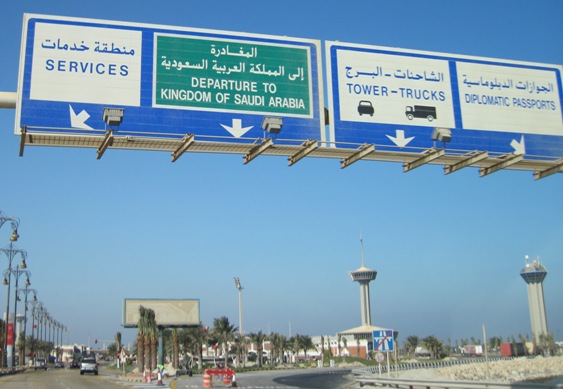
"Just play it cool, Ahmed...!! We'll pretend that we didn't know about the visa requirements...!!" Ahmed's nervous smile told me that I didn't sound very convincing...!!
We approached the border station in a state of some anxiety… Ahmed did not need a passport, but did need a reason to be crossing over…
I had my passport in my pocket, but no visa… Besides my camera, I was also carrying a video camera, and had been filming as we crossed the causeway… This had attracted a number of curious glances from cars and trucks that we had passed… I placed both cameras on the floor between us, hoping that they would not be seen… This in itself would probably be seen as “suspicious” by the border officials…
We stopped at the entrance and eyed the border guards who were checking every vehicle and scrutinizing paperwork…
“I think we should just drive up and feign ignorance…” I suggested to a nervous Ahmed…
Needless to say, after listening to our explanations of wanting to “pop across” the Causeway, we were sent packing…!! But not before I asked a vital question…
“Are we on Saudi soil…?”
“Yes of course…!!” came the reply…
“Brilliant…!! Congratulations…!! You are country number 67 on the Gypsy Biker World Tour…!! I have met an dealt with enough Saudis in the last few weeks for this to count as a visit for me, thank you very much…!! And by the way, you gotta do something about that football team of yours…!! Rather poor showing, what…!! Perhaps a bit of public flogging will get them back to winning ways again…!!”
Leaving the speechless official behind us, we made a hurried exit of the Border Station and headed back to Bahrain…
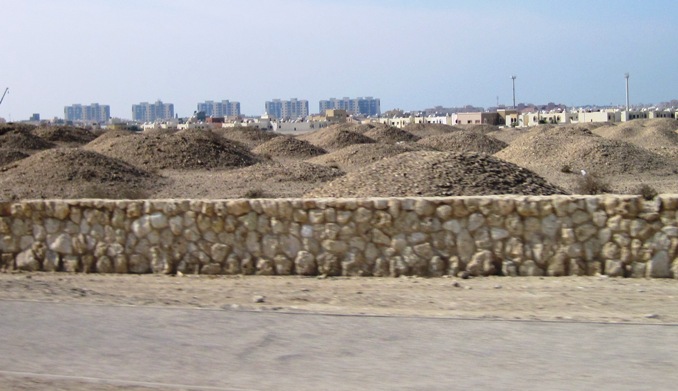
These look like piles of rubble, but they are actually ancient burial mounds...!!
The Causeway was built to strengthen relations between the two countries, and especially single (and married, I suppose…) Saudi men, who stream across on weekends to take advantage of the less stringent liquor laws in Bahrain… Prostitutes also do a roaring trade, I am reliably told…!! Seems our puritanical friends do find some western habits acceptable after all…!!
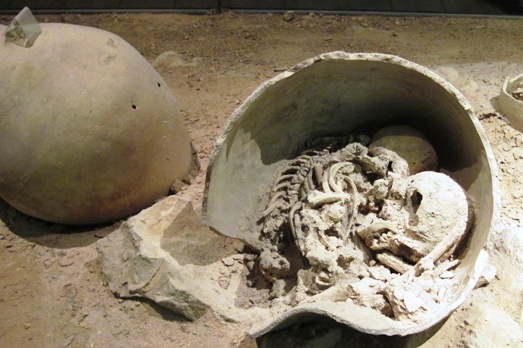
Young children were often placed in large burial pots, such as this one which I photographed at the National Museum later that day...
We passed a vast area that looked as though rubble had been tipped there in piles, waiting to be graded… Malcolm had explained that I would see these along the roads we would be driving on, so I knew them to be ancient burial mounds…
There are almost 85 000 of them scattered throughout the island, and are unique to Bahrain… The date back from 2300 B.C. to around 630 A.D.
In total they cover more than 30 square kilometres, or 5% of the total island’s area… Most are only about 6 metres in diametre, but others are as large as 50 metres in diametre where entire families were buried..!.!
Adults were buried in rock chambers in the very centre of the mound, and children in subsidiary chambers ranging out towards the edges of the mound…
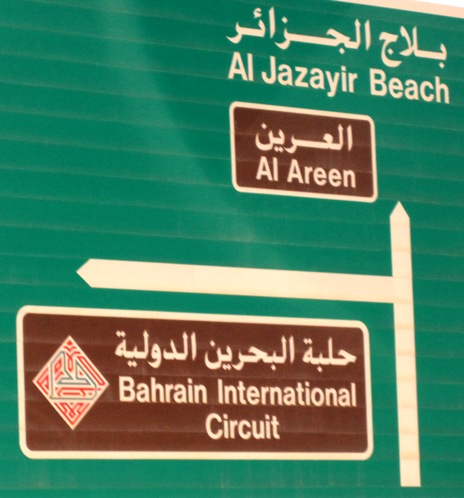
Bahrain built the first F1 track in the middle east...
We had some difficulty in deciding where to go next, but a road sign soon sorted that out…
The Bahrain International Circuit was the first Formula 1 circuit to be built in the Middle East, and was completed in 2004. It was designed by Hermann Tilke, the same guy responsible for the designs of the Sepang, Shanghai, Istanbul and Valencia MotoGP circuits…
It has eight individual tracks, that allow for at least two races to be held simultaneously…!! Apart from the F1 track, there is a drag racing strip, an international Karting track, a 4 x 4 desert obstacle course, the bike racing track and another used for sallon and sports car racing…
The circuit can accommodate over 45 000 spectators, and the long weekend when the annual Formula 1 circus comes to town, is seen by locals as the highlight of their year… It’s a huge event, and tickets for this years event in March, are already selling fast…
I would have liked to have gone into the venue, but a private race day was in progress for invited guests only… Ahmed did not think we would be able to gatecrash the event…!!

"I want my bike...!!"

"Ah well... This will have to do...!! Open the gates...!! Ahmed, give me a push, will you...??"
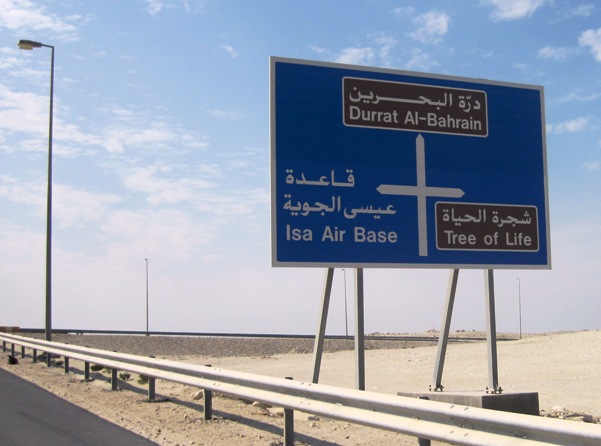
Through the desert to the Tree of Life...after a number of unexpected detours...!!
Next on the agenda was the Tree of Life… I was intrigued by the name and after a long detour, which required us to use the GPS on Ahmed’s I-Phone, we eventually turned onto the highway that led south down the eastern side of the island…
Ahmed had never even heard of this famous landmark, and despite the many jokes we made about it on the way there, was as interested as I was to see what it was all about…
We drove down the coast, passed the Isa Air Base, where many large signs warned that the taking of photographs would result in more than just a tongue lashing from the authorities…
Watchtowers manned by binocular wielding soldiers convinced us that they were not joking… The fact that we were the only vehicle on the road passing the base, and that many eyes were focused on us, made me lower my camera to my lap…
The narrow road lead we were on lead us through a bleak and deserted landscape until we discovered the turnoff to where the GPS advised the Tree of Life was situated… Out in the distance, a single tree stood, it branches spread out around it like a skirt…
“That must be it…1” Ahmed said…
“You think..??” I replied… “It is after all the only bloody tree in sight…!!”
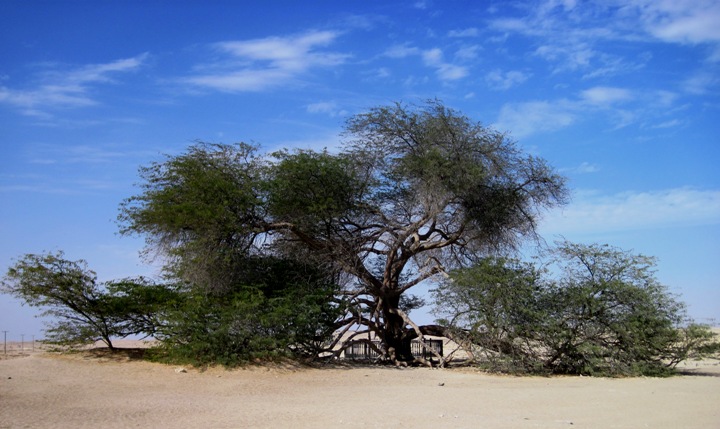
The Tree of Life... The ONLY tree for miles around...!!
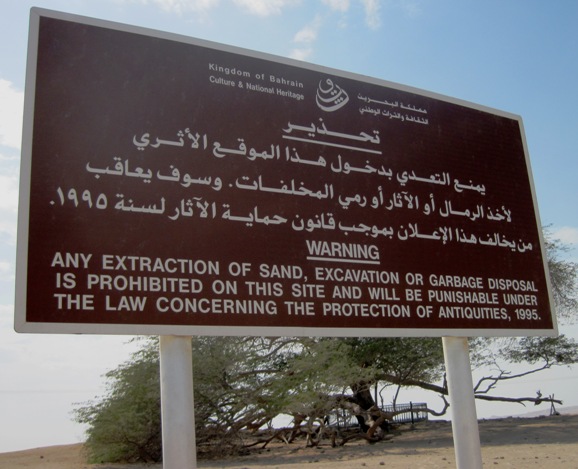
These guys take their national monuments quite seriously....and all we wanted was a bit of firewood...!!
A low three strand wire fence surrounded the mound that the tree stands on…
We drove all the way around it until we discovered the narrow gateway that allowed access on foot… Apart from the large sign warning that we should not remove even the sand that we were walking on, there was not a single bit of information about this tree…
I had to Google the darn thing to find out more, and discovered that this Mesquite Tree is reputed to be about 400 years old, and the mystery about its survival in this the harshest of elements, has made it something of a legend among the local people…
Some of them even believe that this was the original Garden of Eden…!!
Known as the Sharayat-al-Hayat by the Arabs, the tree continues to grow and sprout new leaves and branches each year… Where it gets enough water from to survive is a mystery, but scientists believe that its roots have found their way into an underground spring… Judging by the many tracks of dogs that criss-crossed the area, I like to think that the tree is also aided by liberal applications of urine…
Bedouins believe that Enki, the mythical God of Water continues to sprinkle its blessings on the tree… Yeah, that and the continuous sprinkling by the dogs…
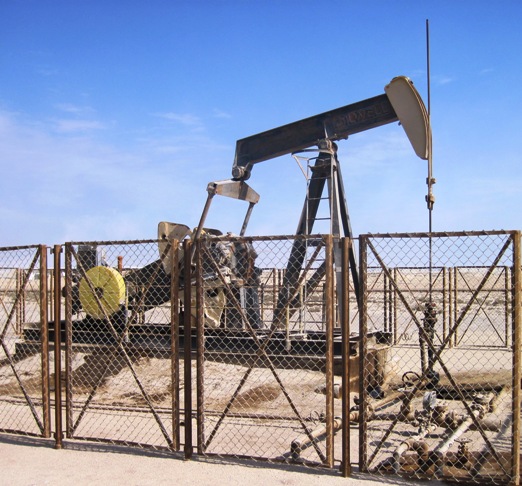
The Nodding Donkey... A common species found throughout Bahrain...
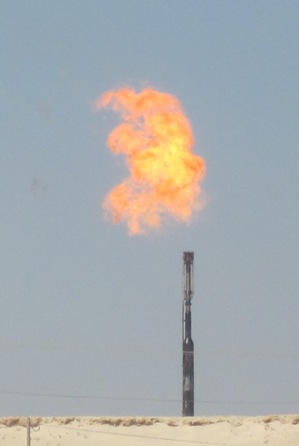
Being a bit short in the Flora department, this is Bahrain's answer to the Flame Lily...!!
Apart from the north-eastern section of the island, which id well developed, the remainder of the island is basically flat and featureless…
Dotted all over the open desert, are the oil wells which brought Bahrain to world prominence… Thousands of kilometres of piping lie in the open, uncovered and unprotected… Of various diametres, they are supported by the smallest of concrete saddles and snake towards the larger holding tanks that then pump the raw crude towards the refineries…
The discovery of oil in 1932, coincided with the collapse of the Pearl industry in Bahrain, resulting in fishermen suddenly finding themselves known as “oilmen”…!!
The first well that was sunk forms part of a museum today, and is located in the very centre of the island… It was the very first oil well ever sunk in the Arabian Gulf…
The first shipment of crude oil from the gulf took place in 1934, and in 1948, natural gas was discovered, all guaranteeing a bright future for the country… After almost 80 years of sucking the Black Gold from the depths of the desert, Bahrain’s oil reserves are quickly running dry…
It is estimated that by 2030, production will be down to only a small fraction of what it once was… A massive program of development in other commercial interests is underway here, and it is hoped that by 2030, Bahrain’s dependence on revenue from oil, will be negligible…
It is remodeling itself as a financial and commercial hub of the Gulf, along with it’s neighbours, Qatar, Abu Dhabi and Dubai…
Ahmed drew my attention to the fact that it was nearing lunch time, and suggested we make a stop to take on some nourishment… I readily agreed and while he drove on to his uncles restaurant, I sat back and considered all that I had seen that morning…
I glanced down at the list I had been referring to from time to time, and saw that there was still four or five places we were due to visit…!!
A busy morning indeed….!!
©GBWT 2011
Great ! Saudi accomplished and dusted. Glad you took the chance.