
After a long and rough ride from Huaraz to Huanchaco, I decided to take the day off…!!

The Huanchaco traditional fisherman have made the town a popular tourist destination... Statues like this one can be seen all along the seashore...
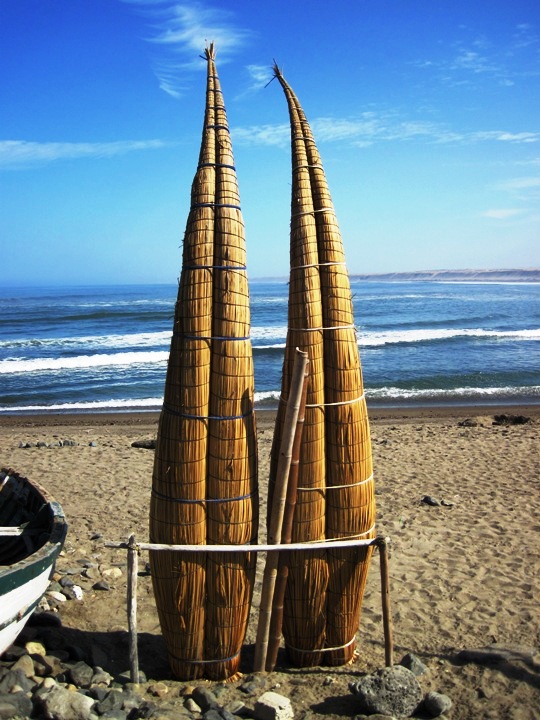
These slim reed craft are used to fish up to a few kilometres off-shore...!! You would not catch me that far out on something made from what amounts to a bundle of sticks...!!
Huanchaco is a place well worth kicking back in for a few days… It is a surfers paradise and many guys and girls from all over the world are here to catch some of the best waves on the Pacific Coast…
I walked along the shorefront in the early morning sunshine, taking in the sight of surfers getting ready to take on the long even breaks that this part of the Peruvian coastline is famous for…
It is said that the first form of surfing in South America, originated right here… Fisherman built narrow craft from the reeds that grow along the rivers edges, and fashioned them into what are today known as caballitos de totora…
They used these to put to see to catch fish, kneeling towards the rear of the craft, and paddling with narrow woooden paddles… When returning to shore , they “surfed” these craft back onto the beach…
The Caballitos de Totoro, is the town emplems, and there are statues paying tribute to the fisherman that still use them today…
Although I hung around for an hour or more, I did not see one put out to sea, although a number of guys were making repairs to their cabillitos and some were being built from scratch…
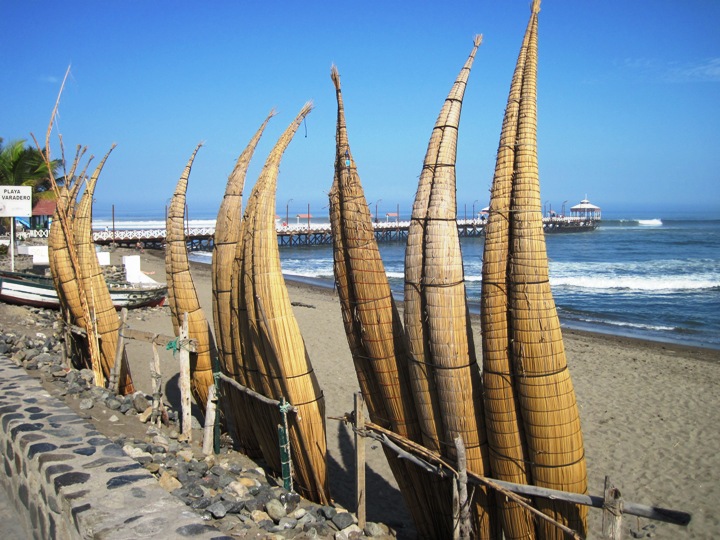
Cabillitos de Totoro's stacked and ready for the next fishing trip...
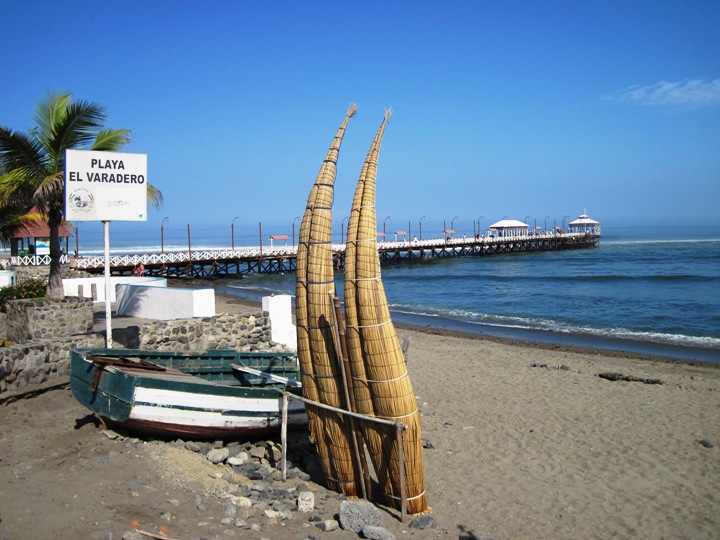
In the background is the pier that some surfers use as a short cut out to the rollers beyond... And Cabillitos everywhere you look...!!
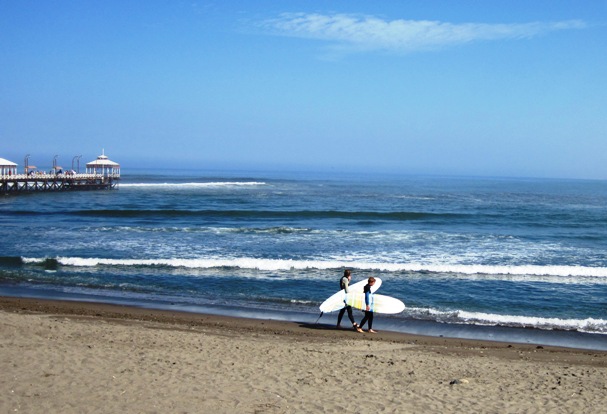
Surfers prepare to paddle out to enjoy the very long surf-breaks that this beach is famous for...
I went on a short trip a few kimometres out of town, back towards Trujillo, to visit the pre-Colombian ruins of Chan Chan…

The old church of San Jose stands alone in the desert sands just outside Huanchaco....
Chan Chan lies on the coastal desert plain, between the main road to Trujillo, and the Pacific Ocean… A well maintained dirt road leads 2 km off the main road, and at one point runs alonside a massive mud brick built wall that once formed the boundary of the city…
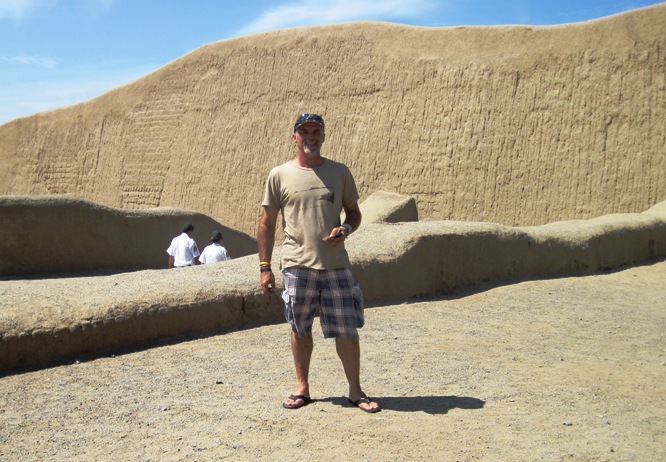
Standing outside the huge walls that guarded the Palace... In places they are almost 20 metres high...!!
This ancient city dates back to 850 A.D., when the Chimu culture dominated the area… It is the largest mud-brick ancient site in the world, and measures almost 20 square kilometres…!! The Chimu built and expanded their empire for over 600 years, and during that period, the countryside around Chan Chan was covered in trees and bush…
The conquistador Francisco Pizarro, was apparently the first European to lay eyes on the city that housed as many as 30 000 people before the Incas arrived to start slapping people around…

The turnoff to the site is well sign-posted and the Peruvian government has made the preservation of Chan Chan a priority, which is surprising considering that Peru is known ostensibly for it's Inca history and very little else...!!
The Chimu ruled the area from the present day Ecuador border, right down to Lima… They accurately measured the seasons and months by using the phases of the Moon and the Sun as guides… The held the pelican and the fish, as well as the squirrel to be sacred, and adobe carvings of these animals can be seen on almost every surface within the city…

To save time and learn a bit, I employed the services of Nancy, a local guide who spoke more than passable English, but kept asking me to correct her pronounciation....!!
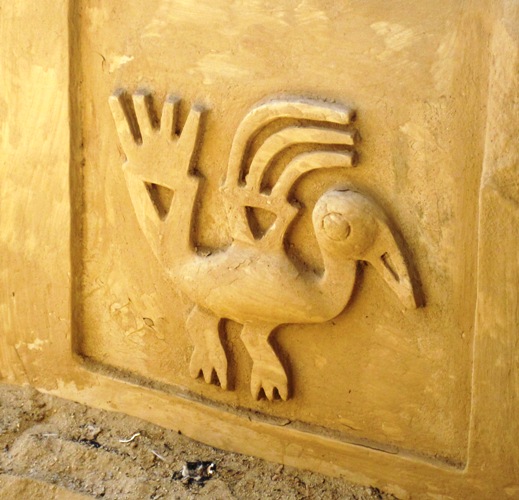
Stylised adobe carving of a Pelican... It is amazing to think that these carving made from mud have survived for over a 1000 years...!!
While many of the carving depicts animals and nets that they used for fishing, there are also many geometric patterns, and others that show similar “steps” or phases of life that the Incas might have adopted…
Open-sided, roofed structures have been built over many of the more important rooms and ceremonial areas of the palace to protect them from further weathering…
Climatic chnages have meant that this area is receiving more rain than it ever used to, and water and mud-brick buildings do not go hand in hand…!!
While Cahn Chan has nothing on Machu Picchu and many other ancient sites I have visited, it is still a place that I found well worth visiting, and enjoyed the simple way that Nancy described how the Chimu lived and worked in and around the city…
Many of the things the Incas came to be well known for, were actually adopted from the cultures they dominated and held sway over… The Chimu might well have taught the Incas about water reticulation, and enhanced their knowledge of agricultural practices…

For every carving of a squirrel with four separate "tails", there is one with three... This showed that the Chimu practiced duality, honouring both men and women, the Sun and the Moon, although the Moon played a more important part in their religion than the Sun did...
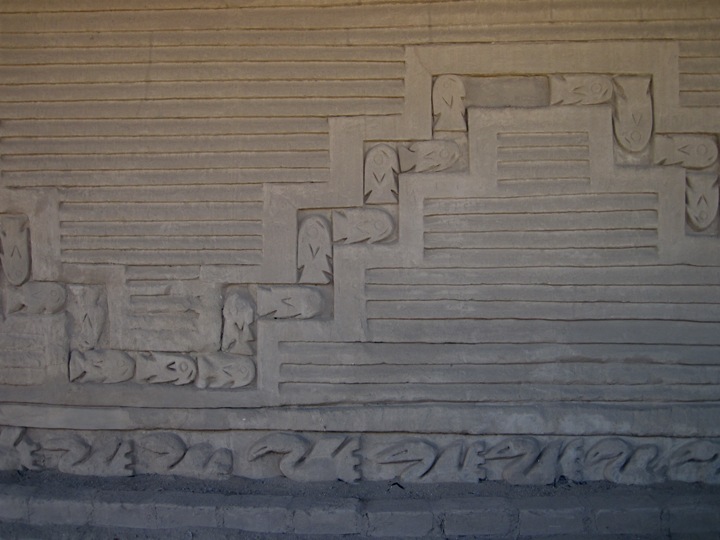
The Fish and the Pelican are by far the most common carvings to be seen at Chan Chan....
The Incas came calling in the 15th century, and laid siege to Chan-Chan, cutting off their water supply until the Chimu gave in… And that brought this ancient civilisation to an end…
The only structure of any significance left today, is the Palace that the Chimu rulers lived in… The reason that it has survived the winds and other natural disasters that this area experiences, is because the outer walls of the Palace were built especially high and thick to protect the king from assault by the ill-intentioned…

The interior of the Palace is a maze of passages, designed to thwart attackers... The wall were also built in a wedge shape, to protect against earthquakes....
The Chimu bilt an intricate network of canals to divert water from the Moche River to the north of the city, and these canals enabled them to irrigate crops in an area where no permanent water was to be found… Many of these canals are still visible today, but both earthquakes and floods have all but eradicated the others…

Inside the Palace is a large pool of water, which springs from wells that were dug centuries ago... This water was for use by the residents of the Palace only... The reeds that have always grown here were used to replace any of the thatch on the roofs that were damaged by winds or rain...
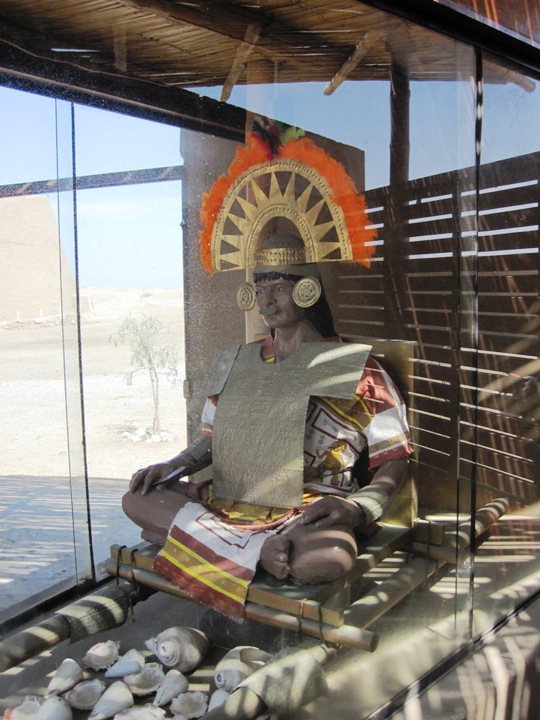
In a showcase near the entrance is this figure depicting what a Chimu king would have dressed like for ceremonial purposes... The gold and silver ornaments held no value to them, apart from decoration....
I spent an hour touring the ruins of the Palace, and although my entry ticket included a visit into the ruins of the city itself, from what I could see, most of it was just the remnanat of the walls of the mud brick houses that the genreal Chimu population lived in…
I needed to get back to my hostal to prepare for my ride the following day, and reply to many emails that were crowding my inbox…!!
But before I left, I ran into the modern day Chimu below, who spoke English with an American accent, and called me “Brother”…!!
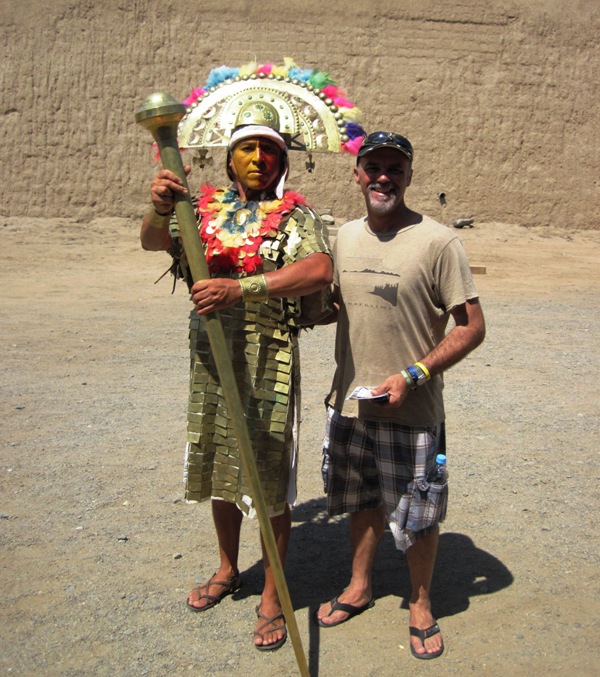
This is what a Chimu chieftain would have looked like... The guy on the left, that is...!!
Out in the car park, I saw a BMW bike heading away along the dirt road, and to my left, stood a KTM with a sticker that immediately drew my attention…
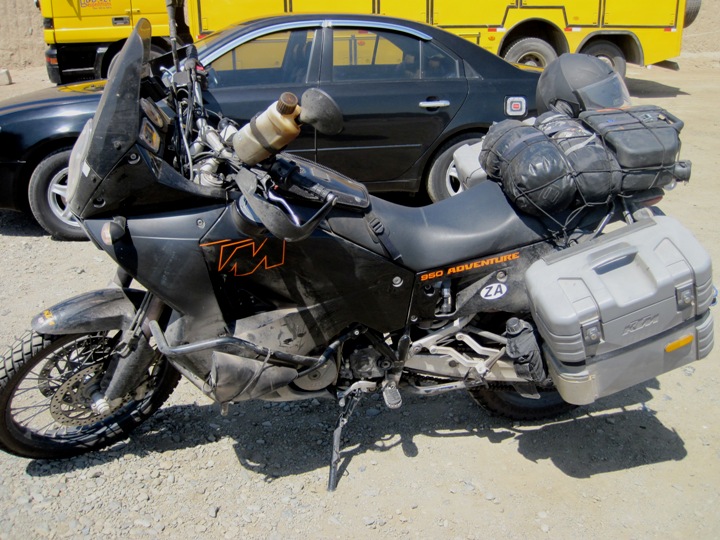
The "ZA"sticker had me wondering if there was a KTM model that I had not heard of...!!
“ZA” is the international designation for South Africa, but the bikes number plate was Italian… I would later discover that the rider had indeed been in South Africa, and got the sticker from there…!!
Little did I know that this bike and the other GS I had seen leaving, would accopmpany me all the way to Bogota in Colombia, and that we would cover almost 2 500 km together…!!
Standing outside the huge walls that guarded the Palace... In places they are almost 20 metres high...!!
As I made my way back down the dirt road, I turned to take a last look at the massive walls that surround the Palace… It was still hard to believe that something made from water and clay was still standing after more than a 1000 years…!!
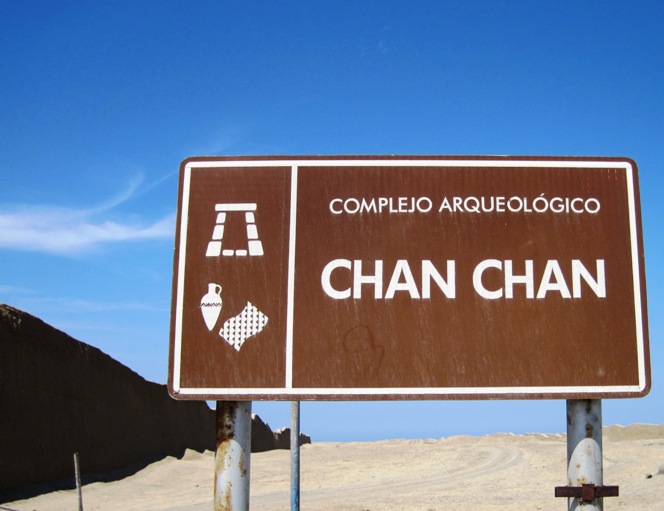
Although my visit was short, it was time well spent...!! Had it not been for Roger in New Zealand, I might well have missed visiting this site...
Back in Huanchaco, I received an email from Nigel who I had met at Lima BMW… He advised that he and his riding partner were in Mancora, further up the coast, and not too far from the Ecuador border…
I sent a reply to tell them that I would see them the following day… Then went out to watch yet another glorious sunset…
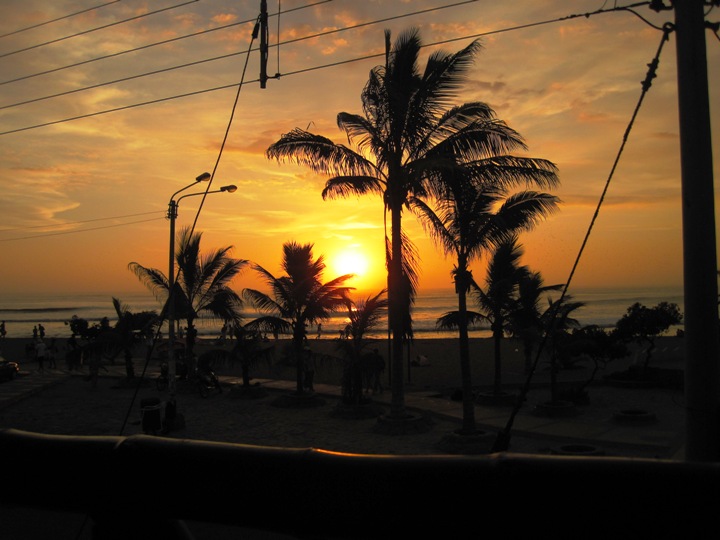
From the balcony of a nearby restaurant, I watched the sun sink into the Pacific....
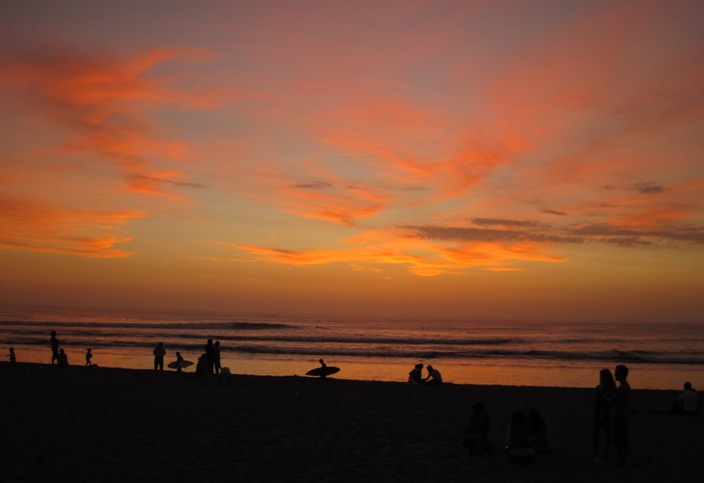
...and weary surfers and beach-goers, pack up and head for their homes... If anything, Huanchaco is surely the place to visit if watching the day turn into night is something you enjoy as much as I do...
©GBWT 2012
Hi Ronnie,I spent a couple of nights at Huanchaco on my way up to Bogota in March last year.
As you say ,a charming fishing village in that stark desert you’re crossing.
It gets a lot better right up north approaching Ecuador.A little like Greek architecture en route.
Then suddenly you’ll be in semi tropical banana plantation country before the border.
Enjoy it.Much nicer as you go north towards Colombia!
Regards
Tony
Nice to hear the history of the place. Hope you were able to rest up a little.